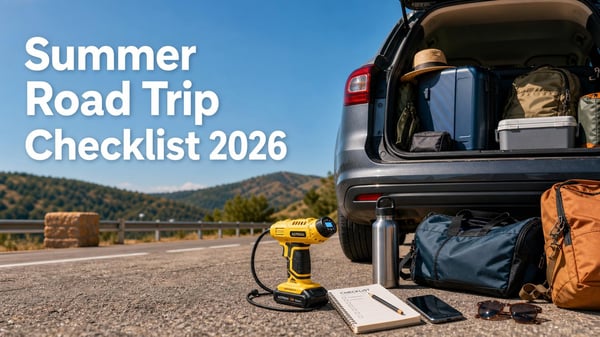
Summer Road Trip Checklist 2026
A useful summer road trip checklist should help you leave at the right time, keep passengers comfortable, avoid preventable stops, and handle small vehicle problems without turning the day into a delay.
Quick Answer: What Should You Pack First?
Start with route planning, weather, cold tire pressure, passenger comfort, water, first aid, phone power, warning gear, documents, and a compact tire inflator. The AstroAI C2 is the stronger road-trip inflator pick when 12V DC backup power matters; the AstroAI L7 is the lighter battery-powered option for smaller travel kits.
1. Plan the Departure Before You Pack the Trunk
The easiest road-trip problems to avoid are the ones caused by leaving tired, rushed, or underprepared. Build the trip around departure timing, rest stops, weather, fuel, and passenger needs before deciding what gear goes in the car.
Choose a realistic first driving block
Plan the first break before anyone is uncomfortable. For families, pets, older passengers, or mountain routes, a shorter first segment usually works better than trying to make up time early.
Put critical items in the cabin
Water, medicine, snacks, charging cables, sunglasses, wipes, and reservation details should not be buried under luggage.
2. Road Trip Preparation Timeline
| Timing | What to Do | Why It Helps |
|---|---|---|
| 72 hours out | Confirm lodging, route options, weather, parking, park reservations, and remote-road requirements. | This prevents surprise detours, late check-ins, and rushed packing. |
| 24 hours out | Check cold tire pressure, inspect tread and sidewalls, top off washer fluid, charge power banks, download offline maps, and pack documents. | Most vehicle and navigation issues are easier to fix before the car is loaded. |
| Departure day | Load heavy items low, keep emergency gear accessible, set navigation before moving, and do a quick lights, mirrors, fuel, and cabin-temperature check. | The car starts organized, balanced, and ready for the first long driving block. |
| On the road | Stop before fatigue builds, keep passengers hydrated, and treat a tire-pressure alert as a reason to pull over safely and inspect the tire. | Small corrections are easier before they become stressful roadside problems. |
3. Summer Road Trip Checklist 2026
Use this checklist as a pre-trip packing and inspection guide for passenger cars, crossovers, and family road trips. Trucks, RVs, trailers, and oversized tires need tools matched to their load and tire size.
| Category | Pack or Check | Why It Matters | Best Timing |
|---|---|---|---|
| Vehicle tires | Cold PSI, tread depth, sidewall damage, spare tire or repair kit | Tires are the first line of safety on hot highways and loaded vehicles. | Morning before departure |
| Tire inflation | Compact inflator, valve caps, tire gauge if separate | Lets you correct low pressure without searching for a working gas-station pump. | Before leaving and after TPMS alerts |
| Roadside visibility | Reflective vest, warning triangle, flashlight, gloves | Makes roadside work more visible and less chaotic. | Keep within reach |
| Documents and money | License, registration, insurance, reservation details, backup payment card | Reduces delays at hotels, parks, service centers, and unexpected stops. | Pack the day before |
| Heat and comfort | Water, electrolytes, sunscreen, hat, sunglasses, small towel, medication | Passenger comfort affects driver focus on long, hot travel days. | Restock every travel day |
| Power and navigation | Charging cables, power bank, 12V adapter, offline maps, mount | Navigation, communication, and photos all depend on stable device power. | Charge the night before |
Vehicle-prep tools
Match the inflator to the trip, not just the PSI number.
A tire inflator is useful when it is already in the car. It should support routine pressure top-offs and low-pressure alerts, while still respecting the limits of the tire and vehicle.
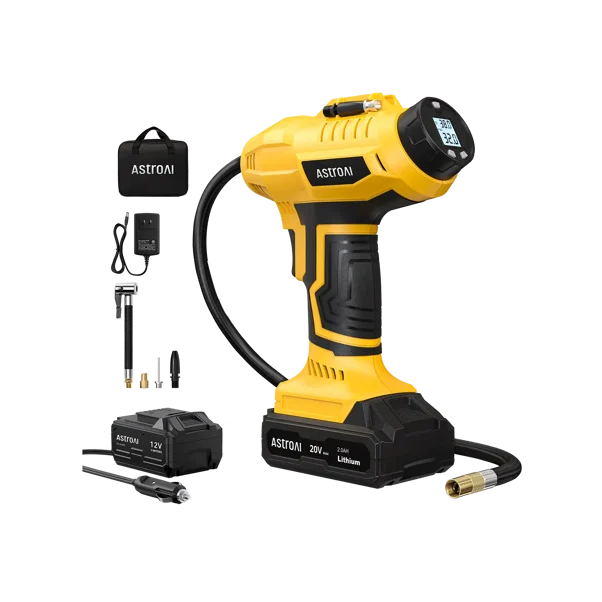
Main road-trip pick
AstroAI C2 Handheld Cordless Tire Inflator
Best for longer road trips, family cars, trunk emergency kits, and drivers who want cordless use plus 12V DC backup power.
- 160 PSI maximum pressure
- 2000mAh battery
- Battery plus 12V DC power
- Not best for repeated high-volume truck, RV, trailer, or oversized off-road tire inflation
- Pros: dual-power backup and useful road-trip flexibility
- Cons: larger and heavier than the lightest compact inflators
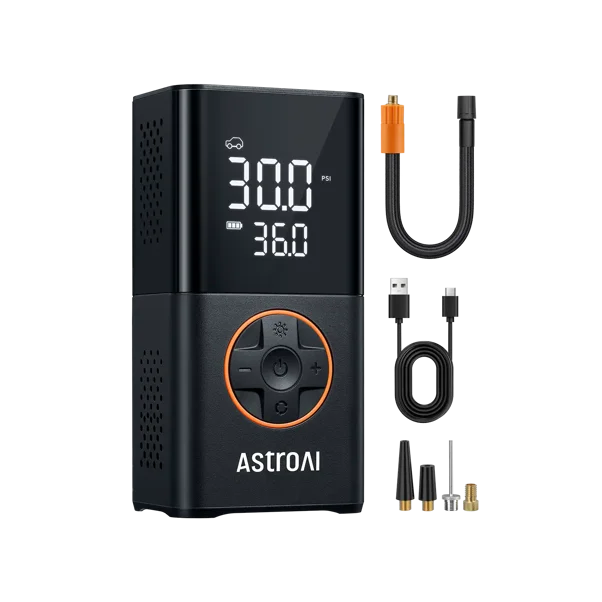
Lighter backup option
AstroAI L7 Portable Tire Inflator
Best for compact cars, motorcycles, bikes, light travel kits, and occasional passenger-car pressure top-offs.
- 150 PSI maximum pressure
- 4000mAh battery
- Battery-powered design
- Not best for drivers who want 12V DC backup power on long trips
- Pros: lighter carry weight and compact storage
- Cons: no 12V DC backup, so charge level matters more
4. C2 vs L7: Which Inflator Fits Your Trip?
| Model | Best For | Key Specs | Limit |
|---|---|---|---|
| AstroAI C2 | Long summer road trips, family cars, trunk emergency kits, and drivers who want backup power | 160 PSI, 2000mAh battery, battery plus 12V DC power, 2.54 lb | Larger than the lightest pocket-style inflators. |
| AstroAI L7 | Compact cars, motorcycles, bikes, light travel kits, and occasional passenger-car top-offs | 150 PSI, 4000mAh battery, battery power, 1.17 lb | No 12V DC backup, so battery management matters more on long trips. |
Product page snapshot checked on 2026-06-29. Prices, promotions, availability, and review counts can change, so confirm on the product page before purchase.
| Product | Product Page Price | Rating Snapshot | SKU / Code |
|---|---|---|---|
| AstroAI C2 | $89.05 USD | 4.8 from 333 reviews | B0948WY5YX |
| AstroAI L7 | $39.99 USD | 4.7 from 2319 reviews | B0CS3B7MD8 |
5. Treat Tire Pressure as a Departure Habit
Pressure checks are most useful before the trip starts. Use the cold tire pressure listed on the vehicle door placard or owner manual, not the maximum pressure printed on the tire sidewall. If a warning appears after hours of highway driving, pull over safely, inspect for visible damage, and avoid relying on inflation alone if the tire repeatedly loses pressure.
How to use an inflator on a trip
Measure cold pressure first, preset the target PSI, attach the hose firmly, and stop to inspect the tire if pressure loss repeats.
When not to rely on inflation
Inflation is not a fix for punctures, repeated pressure loss, sidewall damage, overheating, or tires that are unsafe to drive.
6. Vehicle Emergency and Passenger Comfort Kit
| Need | Recommended Items | Practical Tip |
|---|---|---|
| Visibility | Reflective vest, warning triangle, flashlight or headlamp | Keep these reachable without unloading the trunk. |
| Hands and cleanup | Work gloves, wipes, towel, trash bags, kneeling mat | Small supplies make tire checks and spills less stressful. |
| Heat control | Water, electrolyte packets, sunscreen, cap, sunglasses | Put some water inside the cabin, not only in the trunk. |
| Power | USB-C and Lightning cables, 12V charger, power bank | Pack one backup cable separately so a lost cable does not disable navigation. |
Final Recommendation
For a 2026 summer road trip checklist, put route planning, cold tire pressure, accessible cabin essentials, and passenger comfort first. Keep the AstroAI C2 in the trunk if you want cordless operation plus 12V DC backup power; choose the AstroAI L7 if a lighter battery-powered inflator fits your storage needs better. For larger vehicles or repeated high-volume tire inflation, step up to a heavier-duty compressor sized for the vehicle.
View C2 → View L7 →Frequently Asked Questions
What should I check on my car before a summer road trip?
Start with tire pressure, tire tread, lights, fluid levels, wipers, battery condition, and the spare or repair kit. Summer heat can expose weak tires and low fluids, so it is better to check these items before loading the car.
Why is tire pressure so important for summer driving?
Correct tire pressure helps tires carry load, manage heat, and wear evenly. Check pressure when tires are cold, then set each tire to the vehicle maker's recommended PSI on the door placard or owner manual.
Is a cordless tire inflator enough for a road trip?
A cordless inflator is a strong road-trip choice for passenger-car top-offs and emergency pressure corrections. For repeated large tire inflations, trucks, RVs, or high-volume use, choose a heavier-duty inflator matched to the tire size.
Why recommend the AstroAI C2 for a summer road trip kit?
The AstroAI C2 fits road trips because it combines cordless use with 12V DC backup power, 160 PSI maximum pressure, and preset auto shut-off. That makes it practical for rest stops, campsites, and driveway pre-trip checks.
When should I choose the AstroAI L7 instead of the C2?
Choose the AstroAI L7 if you want a lighter battery-powered inflator for compact storage, motorcycles, bikes, and occasional passenger-car top-offs. Choose the C2 if 12V DC backup power is more important for a long road trip.
Should I lower tire pressure before driving in hot weather?
Do not lower a properly set cold tire pressure just because the day is hot. Tire pressure normally rises during driving, so use the cold-pressure recommendation from the vehicle placard rather than bleeding air from warm tires.
What should I keep in the car besides a tire inflator?
Pack water, basic first aid, reflective warning gear, a flashlight, charging cables, offline maps, paper copies of key documents, snacks, sun protection, and a compact tool kit. The best kit covers both vehicle problems and passenger comfort.